Tuesday, 29 October 2013

The Manchurian Candidate (1969) & (2004)


The Manchurian Candidate (1969)

Director:

 John Frankenheimer

Writers:

 Richard Condon, George Axelrod 

Stars:

 Frank Sinatra, Laurence Harvey, Janet Leigh


The novel of the Manchurian Candidate came out in 1962, while the film was released in 1969.
The Manchurian Candidate is a political thriller about the son of a prominent US political family who is brainwashed into being an assassin for the Communist Party.


The trailer for the Manchurian Candidate is made to create suspense and terror towards the audience, as it is about communism. This would invite the audience to watch the film, as they like to know what is going to happen in the film. 


This classic scene in the Manchurian Candidate is a key scene, as it shows how easy it is for Raymond shaw's mother to brainwash him into  doing anything she asks. Although Raymond does put up a fight. 


The Manchurian Candidate (2004)
The Manchurian Candidate (2004) Poster

Director:

 Jonathan Demme

Writers:

 Richard Condon, George Axelrod

Stars:

 Denzel Washington, Liev Schreiber, Meryl Streep 

In the midst of the Gulf War, soldiers are kidnapped and brainwashed for sinister purposes. This is modern version is based around the novel and old 1969 version of the Manchurian Candidate.


The trailer for the modern Manchurian Candidate is a past pacing one. As it draws the audience in to find out more about the Manchurian Candidate. It appeals to the audience as it is modern and easy to understand. 


The opening scene of the modern Manchurian Candidate sets the initial battle in Kuwait, which makes it easier for the audience to relate to. The flashback of the battle is far better than the original one. There is explosions and uses of night vision goggles, making the attack seem more believable.
Production values has changed and increased since the original Manchurian Candidate in 1969. The flashback scene is red, which represents blood and the subconscious mind. 

The Brain washing scenes are completely different. The original version has the soldiers switching from Communist soldiers to ladies at a tea party. To show hypnosis. While the modern version is more graphic, as it has scenes of brain implants and drilling. 

The original version of the Manchurian Candidate was completely full of racial stereotypes. For example they though there was mysterious and dangerous men from the east. They also had an Asian servant. Token black soldier. The modern version had a black protagonist who saves everyone. Which promotes a more multiracial society.

Both Manchurian Candidates refer to social and historical context and of tension and threat. The power of Global companies and the threat to democracy. The main purpose of the film wasn't just for entertainment but also to inform. The director says that the film is sadder, darker
  and stranger than real life, which i agree with as there isn't actually people in real life that brainwash people. Although, no one knows. 


Friday, 25 October 2013

Lighting Exercise

Lighting


Lighting 

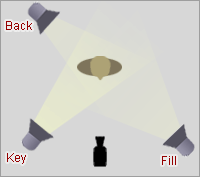
Lighting is a key part of films because lighting can describe a story line without dialogue, which also sets the mood and atmosphere.   


The key light = is the brightest light which is the most influential, as it is the one which that is the most important light. 

The back light = helps black out features which creates an outline of an peron.

The filler light = is the light that softens the shadows of a person or object that the back light creates.

Underlighting = is when the main lighting comes form below the object or person, which is normally used in horror and thriller films. 

Top lighting = is when the main lighting comes from the top, which is used to create a glamourous look.

Back lighting = is when the lighting is behind the object or person, where silhouettes is created. 


Wednesday, 23 October 2013

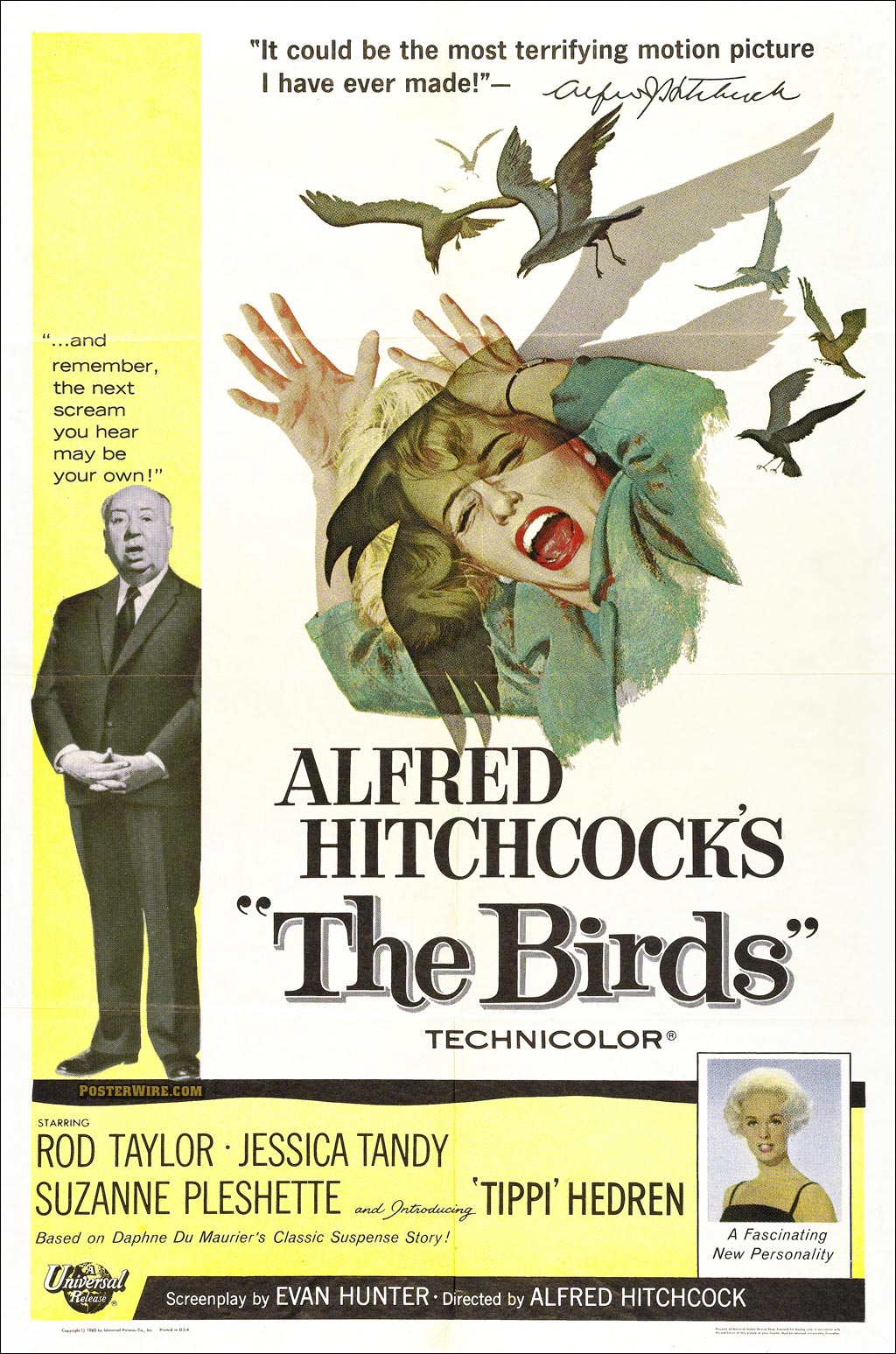
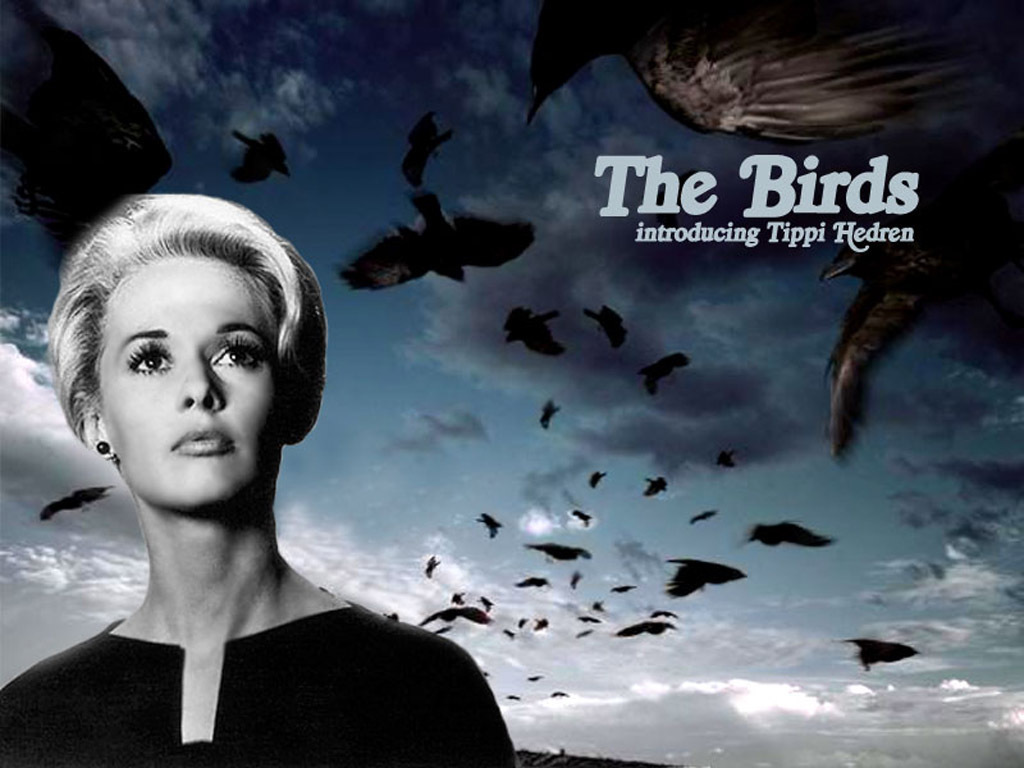
The Birds (1963)


The Birds 1963

119 min  -  Horror | Thriller 
Director:
•Alfred Hitchcock 

Writers:
•Daphne Du Maurier, Evan Hunter 

Stars:
•Rod Taylor, Tippi Hedren and Suzanne Pleshette

Melanie is a rich San Francisco socialite, who takes her boyfriend to a town in California. The town slowly becomes bizarre when different types of birds suddenly begin to attack people. Which increases and starts to become more viscous. 


The Birds has many aspects of a typical thriller, for example it has a lot of mystery and a hero.Which a typical thriller would have. 
In The Birds, the external threat actually comes from nature. This puts the audience on edge as this is something they can't control. In a lot in Hitchcock films, he makes it so that there is nowhere for the characters to run. An example of that is shown in the Bodega Bay scene. The hero in The Birds is Melanie's boyfriend Mitch who gets himself, Melanie, his sister and mother away from the birds safely in the ending scene. This ending scene called the unending terror, has a huge cliffhanger as we don't actually know what happens after they leave the house. The name unending terror creates suspense, as the audience begin to feel on edge as the bird mystery hasn't actually been sorted out.

Hitchcock said thrillers allow the audience to "put their toe in the cold water of fear to see what it's like” Which is true.


The trailer of The Birds appeals to the audience, as it grabs their attention because it seems to have really fast action in it. They can tell that it will be very interesting and thrilling.  


Thrillers are characterized by fast pacing and frequent action which does appear in The Birds for example in the eyes pecked out scene. There is a lot of silence throughout the scene. Which builds up tension till the audience is able to see the man with the pecked out eyes, which shocks them completely.  


Another example of fast pacing action is the trapped in a phone booth scene. As we the audience are focused on the action as there is fire all around Melanie and she is trapped in the middle in the phone booth, because she is surrounded by birds. The audience are on edge, they don't know if she will make is out of there alive. The birds smashing into the booth window and cracking it, adds to the past pacing action. 
Dramatic irony is used in The Birds, as in the schoolyard scene Melanie doesn't know the birds have been gathering outside. Although the audience do, which gives them more information than the character.
There is a MacGuffin in The Birds but it is ambiguous meaning we don't quite understand it it. There are different interpretations of it. It creates potential threat and cannot be explained.The MacGuffin is a big part of thrillers.

As when the audiences left the film's UK premiere at the Odeon, Leicester Square, London, they were greeted by the sound of screeching and flapping birds from loudspeakers hidden in the trees to scare them further.

Monday, 21 October 2013

Psycho (1960)

Psycho (1960)


Director:
Alfred Hitchcock
Actors:
Anthony Perkins, Janet Leigh and Vera Miles


Marion Crane is annoyed with the way life has treated her. She cannot get married to her lover Sam, as he gave most of his money away in alimony. Marion is then trusted with $40,000 by her employer, which she should bank. Although she see's this as an opportunity to run and start a new life. After leaving town, she heads off to Sam's store in California but ends up being tired. So she stops at a near by motel.  At the beginning of the film the motel owner seems like a quiet kind man, who is dominated by his mother. 


In Psycho, the audience automatically think the film is about an $40,000 murder. Although they become shocked as anything and anyone could be killed. Now the audience know there is a murderer in the house, but they don't know when they'll strike. Hitchcock made it clear that as apprehension  increases  there is less violence shown on screen. 


Psycho is an archetypal thriller, which has a mixture of unstable characters and a bit of mystery and thriller. Although there are elements of horror. The threat in Psycho is a man who has a very disturbed mind who also happens to be the motel owner.


Thrillers are inspired by fast pacing and continuous action. For example in the shower scene. In the shower scene, continuous action occurs as the killer enters the bathroom while Marion is in the shower then repeatedly stabs her. This creates fast pacing as the audience didn't expect this to happen. Marion the starts to slip down the bath slowly, which adds to the continuous actions


Also the staircase scene is another, fast pacing action scene as the audience see the point of view of the killer. Which adds to the action as we the audience know what is coming next.


There is a hero in Psycho, Marion's lover Sam. As he is the one who finds Norman and stops him from killing Marion's sister.

Hitchcock said that it was really important to get rid of cliche and repetition things. For example the murderers could be charming while the heroes could have a lot of flaws.

Psycho is a shocking film, as a lot of tension and suspense is built up. From the shower scene to the reviling scene of the mother. Hitchcock consistently breaks expectations and shocks the audience completely, as they didn't expect the mother to actually be Norman himself. The biggest shock for the audience was the early exit of Janet Leigh. This was a undoubtedly unexpected shock, as at this point the screenplay had tricked the audience into accepting Marion as the main character which is a really good example of a red herring.


None of Hitchcock's films as had the impact upon the American psyche as Psycho did. When it was released in 1960, it was a huge box office hit and its popularity has not waned over the last four decades.Whenever anyone speaks about Psycho, the first images that come to mind are those of Janet Leigh being hacked to death in the shower. The scene is so famous that even people who have not seen the movie are aware of it. Bernard Herrmann's strident, discordant music has been used in countless other movies to denote the appearance of a Psycho. The brilliance of the scene lies in the editing. Those who go frame-by-frame through it will note how much is left to the imagination. We don't actually see Marion get Stabbed, although our imagination made it seem that way. 


Saturday, 19 October 2013

Sound exercise evaluation


The sequence my group filmed was a mini thriller where there is a lot of weird sound, that is heard. We did include all the sound techniques, apart from the sound bridge as it wasn't possible for us to. 
The first mistake that everyone in my group did, was that we didn't check the mic properly. Which resulted in us recording our sound exercise and when it came to editing there was no sound two. This lead to us to re-recording our sound exercise which is currently on my blog. Next time we will check the sound mic properly.
The first sequence we filmed was the phone scene, where the girl felt uneasy and was calming herself by listening to music. Which we the audience don't actually hear. We didn't include the diegetic music as we forgot to. 


The second shot we filmed was the slamming of the door, which we captured effectively. We used the sound equipment properly, as the slam was loud. This created diegetic sound as both the audience and characters can hear the door slam. The use of parallel sound was also good too.
The next sequence filmed was the pan of the girl silently breathing, there was little diegetic sound. We didn't use the sound equipment effectively and also we didn't differentiate between diegetic and non diegetic sound.  Although we did show a difference between off screen and on screen, as the audience don't know where the sound is coming from. 
The fourth sequence filmed is of the white board that has writing on it. The sound is used effectively  as we used non diegetic sound to engage the audience. Off scene is used to do this. Parallel sound is used, as the scary music matches the action on screen. 
The next sequence filmed is the rattling of the door handle. Which captures the sound extremely well as it sound like the person on the other side of the door is really trying to get in. The sound is diegetic which show's on screen sound. Parallel sound is used as the action matches the sound. 
The last the sequence we filmed was where the both the sound and sound equipment was used the most effectively.  The sound of the breathing, running and screaming was diegetic and also they were all off screen sound, as the screen is blacked out and the audience cannot see the where the sound is coming from or the action. If the action was seen, then it would be parallel sound. 

Overall because it was our second sound exercise, most of the film went well with sound as it was heard clearly. Although the improvements that need to be made are, we should properly check all our equipment is working. Lastly we should make sure to double check, so we don't forget to add or edit anything. 


Monday, 7 October 2013

Sound

Sound

  • Diegetic = refers to the world of the text e.g.dialogue and music.
  • Non-diegetic = refers to everything outside the world of the text e.g.music and a voice over.

The last king of Scotland
 Diegetic
 Non-diegetic
 -knocking on the door
 -music
 -phone ringing
 -whispering
 -car engine 


28 weeks later
 Diegetic
 Non-diegetic
 -screaming
 -music
 -glass breaking

 -breathing

 -dialogue


Rat Catcher
 Diegetic
 Non-diegetic
 -screaming
 -without the non-diegetic sound the film feels more realistic
 -dialogue


  • On-screen sound = the audience can see the source of the sound.
  • Off-screen sound = the audience can't see the source of the sound.
Off screen sound enables the extension of the diegetic world. 

Butch Cassidy and the sundance kid
 On-screen sound
 Off-screen sound
 -train stopping
 -Sheriffs on their horse's following the men
 -dialogue

 -horse's galloping 

 -breathing


  • Parallel sound = matches the action
  • Contrapuntal = doesn't match the action
Jaws

 Parallel
 Contrapuntal

 -having fun at the beach, the scary music comes on

  • Sound bridge = helps create a smooth transition from one scene to another. For example, once upon a time in the west.


Sunday, 6 October 2013

Cinematography

if the prezi is not found please use this link: http://prezi.com/0u6gpouonc8c/cinematography/#

Saturday, 5 October 2013

Camera exercise writing assessment

Camera exercise - writing assessment

In my groups camera exercise, the story we were trying to create was of a girl who was lost in a large building that appeared to have something else in it. This caused her to develop paranoia and try to exit the building which started off to be difficult as she was being followed.


We did try to include all different shot types and camera movements, but we didn't manage to, as we had to learn how to use the camera first which took up some our camera time in the beginning. Also we didn't get use every shot due to the fact we didn't know how to do them.

These are all the different camera techniques:

  • Long shot
  • Medium shot
  • Close up
  • Extreme close up
  • Point of view 
  • Over the shoulder 
  • Low angle
  • High angle
  • Pan
  • Tilt
  • Crane shot
  • Tracking shot 
  • Rolling shot
Long shots were used during the camera exercise, as we needed a lot of long running shots. We used this particular shot to create a scene as we needed something to start the camera piece off with, that would grab the audience’s attention but would also cause confusion as they don't know what is happening. The movement of running empathised that the girl was being followed. The long shot was then again used to show the audience who is following the girl. These long shots were successful as the action was captured and is great for the camera exercise.

The next shot used was the medium shot. This was used to draw the audience in so they can see the action, as the girl gets pulled through the door. This adds suspense to the camera exercise. The medium shot was also successful as the audience don't miss any action in that scene.

The medium shot is then used effectively to cut to the next camera shot which is the close up. The girl has escaped again and is heavily breathing against a wall, which the close up shot shows. We choose this shot, as we could show the audience that the girl is safe and also to show her relief. This was a great shot. Another medium shot was used to show the girl running again as she is looking for an escape. 

This then cuts to the next shot, which is the low angle shot. This is used to show how fast the girl is running down the stairs as she is scared and wants to leave the building as fast as she can. This was used effectively as it was cut from the medium shot which was presented well. 

Lastly, the point of view shot was used effectively. It told the audience, as the girl walked through the doors, that she is finally free. This was a good idea as it put the audience in the girl’s shoes just for a moment so that they can feel the relief she feels, as she has escaped.  This was a very successful shot.

My technical capabilities were quite good, although at the beginning I did not hold the camera shots steady. As I had never used a cam recorder before, which I quickly adapted to and learned how to use it properly. That led me to then start to shot each frame more appropriately. 


In conclusion, the most positive elements of my groups film was all the long shots, as I filmed them all appropriately which gave the film more of a depth and made the story line flow. In all of this, the camera exercise still needs improvements, as it isn't long enough and also it needs more camera shot ranges, as the same camera ranges are repeated. Which in some ways makes the camera exercise develop, but also make it boring.